Learn / Blog / Article
How to optimize your marketing funnel for the customer journey
Ask 10 marketers about marketing funnels and you’ll probably get 10 different answers. Why is that? A marketing funnel isn't a one-size-fits-all strategy; your marketing funnel is uniquely tailored to how your buyer buys.

Summary
Your marketing funnel provides more value to your marketing strategy when you understand your customers, helping you make informed decisions to improve the customer experience for people moving through the funnel.
Our goal with this guide is to help you get the most out of your marketing funnel. In this introduction, we cover:
The key takeaway? Every marketing funnel is unique and should be designed for how customers buy—not how you want to sell. Combining quantitative and qualitative data helps you understand how real customers shop and behave on your site, so you can optimize your marketing funnel for the customer journey and increase conversions with a customer-centric marketing strategy.
🔍 Learn what works (and what doesn't) at each stage of the marketing funnel
Use Hotjar to optimize your marketing funnel for the customer journey and increase conversions.

What is a marketing funnel?
A marketing funnel is a series of stages that guide prospective customers along the journey toward engagement and conversion. Funnels help marketing teams plan and measure efforts to attract, engage, and convert prospects through content and other marketing materials, like landing pages and ads.
Marketing funnels are commonly based on the AIDA model:
Awareness → Interest → Desire → Action
But you can simplify the funnel into a three-stage model:
Top of the funnel (TOFU): awareness stage
Middle of the funnel (MOFU): consideration stage
Bottom of the funnel (BOFU): conversion stage
You can rename or add stages like ‘loyalty’ and ‘advocacy’ to any funnel model, but the function of the marketing funnel—to attract, engage, and convert leads—remains the same regardless of how you identify specific stages.
Marketing funnels vs. conversion funnels vs. sales funnels
Marketing funnels, conversion funnels, and sales funnels are thought of as interchangeable, but it’s important to understand the subtle differences between them.
Marketing funnels generate leads. They attract prospects at the top and help marketers measure and track efforts to engage and convert prospects in the middle and bottom.
Conversion funnels generate sales. They capture the entire customer journey from awareness to conversion, which could mean buying a product, completing a form, signing up for a list, or another type of micro-conversion.
The sales funnel is more specifically designed to turn leads into paying customers: as such, one objective of marketing funnels is to turn marketing qualified leads (MQLs) into sales qualified leads (SQLs).
The primary difference between marketing funnels and sales funnels is the way the conversion stage is defined. Generally, a site visitor who’s signed up for your product or a free trial has reached the end of the marketing funnel.
Marketing funnels are also broader in scope, especially if you break down the bottom of the funnel into different stages.
If you go beyond the conversion or purchase stage, the marketing funnel also includes a loyalty stage that consists of turning one-time customers into repeat customers. This step usually entails marketing tactics like loyalty programs and other forms of continued relationships. Finally, the very last of the marketing funnel stages is about turning those loyal customers into brand advocates of your brand.
Marketing funnels, conversion funnels, and sales funnels are thought of as interchangeable, but it’s important to understand the subtle differences between them.
Marketing funnels generate leads. They attract prospects at the top and help marketers measure and track efforts to engage and convert prospects in the middle and bottom.
Conversion funnels generate sales. They capture the entire customer journey from awareness to conversion, which could mean buying a product, completing a form, signing up for a list, or another type of micro-conversion.
The sales funnel is more specifically designed to turn leads into paying customers: as such, one objective of marketing funnels is to turn marketing qualified leads (MQLs) into sales qualified leads (SQLs).
3 stages of the marketing funnel
The traditional funnel model is linear, beginning at the top of the funnel and ending at the bottom, where your prospects convert.
Unfortunately, marketing funnels don’t always work like this in the real world. People don’t always jump into a funnel right at the top and progress step by step through each stage until they come out the bottom, a new customer.
The marketing funnel—like people's real-life buying behavior—is nonlinear, which is why it's important to understand the customer journey from the moment of awareness to the moment of conversion.

1. Top of the funnel: awareness
The top of the funnel (TOFU) is where prospects become aware of your brand and engage with it for the first time. They might not know a lot about your product or service yet, so this stage focuses on content and marketing material that promotes brand awareness.
Use this lead generation stage to attract prospects, and show them what you have to offer:
Include content pieces that educate potential customers about concepts related to your product or service in your content marketing and search engine optimization (SEO) strategy
Create a landing page or infographic that introduces your brand, service, or product to new visitors
Share a post on social media that highlights your unique selling proposition (USP)
Use paid ads on social media and in podcasts that are relevant to your target audience
2. Middle of the funnel: consideration
Potential customers enter the middle of the funnel (MOFU) once they’ve engaged with your brand in a meaningful way: maybe they’ve subscribed to an email list, are following you on social media, or have signed up for a webinar.
Use this stage to engage with prospects—to earn their trust and set your brand apart:
Write an article or white paper that provides value, answers a question, and solves a problem for your potential customers
Invite visitors to participate in a survey to learn more about the drivers, hooks, and barriers of your brand
Share case studies and product comparisons
Create landing pages specific to individual customer segments
3. Bottom of the funnel: conversion
The bottom of the funnel (BOFU) is the last place prospective customers go before they convert. You’ve gotten their attention, built trust, and fostered a relationship with them.
Use this stage to convert prospects—give them specific reasons to choose your brand over your competitors:
Offer a trial or demo so visitors can experience your product or service first-hand
Write a how-to guide or article that answers questions and eliminates any doubt, or blockers potential customers may experience
Share social proof, like customer reviews and testimonies, to build even more trust
Make feature and price comparison charts easy to access and understand
Send segmented email marketing campaigns and use on-site surveys—for example, send an email to users who have abandoned their shopping cart, or place an exit survey on your checkout page
💡 Keep in mind: every customer experiences your marketing funnel differently. You might create content for the top of the funnel, but that doesn’t necessarily mean that customers can only access it at that stage. For example, someone might jump directly to the middle or bottom of the funnel because they’re already aware of their problem and your solution, and are ready to purchase.
4 marketing funnel metrics you should measure for success
Understanding your customers requires observing and communicating with them—not just looking at numbers on a chart and making assumptions. To measure your marketing funnel's success, you need both quantitative and qualitative data.
That said, there are still some key quantitative metrics to consider when measuring your marketing funnel's success and effectiveness.
1. Cost per acquisition (CPA)
CPA measures how much you’re spending on marketing to acquire each new customer. Teams usually look at this number to analyze their paid advertising, email marketing, social media posts, and other paid marketing efforts.
To get this number, divide the entire cost of your marketing campaign by the number of conversions. From there, the idea is pretty simple: if the cost outweighs the gain, you might want to consider ending the campaign or testing alternatives.
2. Customer lifetime value (LTV)
LTV (or CLV) measures the continuous value a customer brings to your company. This metric is all about customer retention, which carries particular weight for SaaS (software as a service) companies because subscribers pay regularly. However, LTV also gives insight into industries like ecommerce and traditional sales—if you can predict the likelihood of a customer making another purchase.
💡 Keep in mind: CPA and LTV are affected by factors like marketing and company costs and how you price your product or service. It's hard to know how much prospective customers are willing to pay, especially if you're a SaaS startup. Market research alone won't tell you how much to charge—you have to test prices and listen to your customers.
📚 Read more: learn which factors to consider when pricing your SaaS product.
3. Conversion rates
Conversion rate measures the frequency of conversions. Some marketers only focus on the final conversion—sales—but you can measure each stage's success through micro-conversions, click through rates, or specific goal conversions. For example:
TOFU conversion: how many visitors convert to marketing qualified leads (MQLs)
MOFU conversion: how many MQLs convert to sign-ups or subscribers
BOFU conversion: how many sign-ups or subscribers convert to customers
Measuring goal conversion rate allows your team to make more informed conversion rate optimization decisions about each funnel stage rather than just the final outcome.
4. Conversion rate per channel
Each marketing channel has different goals, so it’s important to analyze the success of each one. These channels might include
Organic search
Paid ads (Display, SEM, Social, Podcasts)
Referrals and influencers
Email
Like with goal conversions, teams with clear definitions for conversions in each channel will have an easier time measuring success. Ask yourself:
Is clicking on a paid ad a conversion?
Is responding to an email a conversion?
Is signing up for a newsletter a conversion?
Answering questions like these helps you identify what you want from each channel, so you can measure whether it’s working or not.
🔍 Learn what works (and what doesn't) at each stage of the marketing funnel
Use Hotjar to optimize your marketing funnel for the customer journey and increase conversions.
4 tools to increase conversions throughout your funnel
When you focus on measuring quantitative data (i.e. numerical data) without considering qualitative data (i.e. how people experience your marketing funnel and how they think or feel throughout their customer journey), you’re missing an important part of the picture.
Here’s a roundup of four tools that combine quantitative and qualitative data in one place to help you increase conversions throughout the marketing funnel.
Funnels: to identify where users drop off
Heatmaps: to understand user behavior
Session recordings: to understand individual journeys
Surveys: to get user feedback
Identify where (and why) users drop off with funnels
Hotjar Funnels shows you exactly where users drop off (instead of proceeding to the next step) in your digital marketing funnel. It lets you define the key stages of your users’ conversion path and visualize where they abandon your site. This allows you to compare conversion rates across traffic channels to measure the effectiveness of your marketing campaigns.
For example, you can find out which kind of landing page traffic converts better between two different paid ads campaigns, or which of two affiliates brings in the highest-converting traffic. You can even track the performance of a control and variant page when running an A/B test.

2. Understand user behavior with heatmaps
Heatmaps show popular (red) and unpopular (blue) areas and elements on your page, and reveal how people interact with your site. Analyze website heatmaps with the Hotjar Heatmaps tool to identify page elements that are (or aren't) moving people through your funnel.
Once you have insight into how users behave on key pages of your site, you can focus on making changes that increase conversions—ditch the efforts with less rewarding outcomes or A/B test alternatives.

🔥 A heatmap example for the top of the funnel (TOFU): look at heatmaps on pages that are a part of your TOFU strategy, like blog and landing pages.
Let's say you want visitors to click on a call to action (CTA) you've placed at the bottom of a landing page. A scroll heatmap might show that only 20% of your visitors make it to the bottom of the page—which means 80% of them don’t even see your CTA. In that case, you could try moving the CTA (or adding another CTA) to the middle or top of your page.
After you've optimized your page, look at heatmaps again to learn whether the change impacted your conversions.

3. Understand individual user journeys with session recordings
Session recordings capture website visitors' actions—like mouse movements, clicks, taps, and scrolling—so you can see how real users engage with your website from page to page.
Insight from recordings helps you identify blockers or pain points users experience throughout their journey on your site—like broken elements, website bugs, or a confusing design—which might reveal why users drop off at a particular stage or touchpoint of the funnel.

🔥 A session recording example for the middle of the funnel (MOFU): use Hotjar Recordings to segment and filter recordings of pages that are part of your MOFU strategy, such as category and product pages, guides and how-tos, case studies, and comparisons.
Let’s say you want users to add a product to their shopping cart from your product comparison page, but the page has a high exit rate and hardly any conversions. A session recording could reveal that users are rage clicking on a non-clickable element and are exiting out of frustration. In that case, you could try removing the element, or making it clickable so the page is more intuitive to how real people interact with it.
After you've fixed the page, watch session recordings again to see whether the change improved the user experience (UX). A great way to check for bad experiences is to filter Hotjar session recordings by ‘Frustration Score’ to watch users who had a frustrating user experience and spot improvement opportunities.
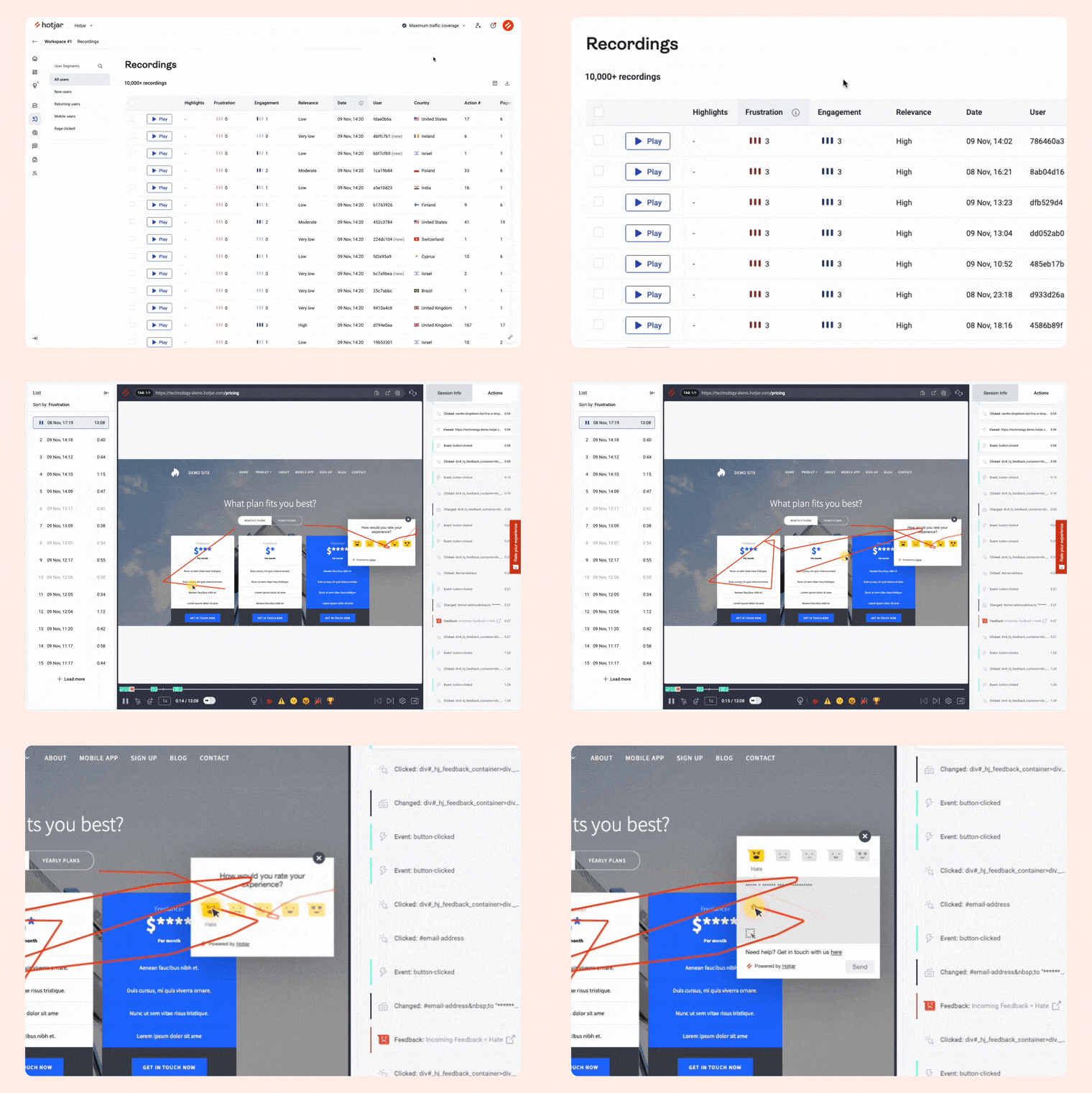
Hotjar also integrates with website testing tools like AB Tasty and Optimizely; you can filter Recordings by Optimize experiments to test variants and measure results.
Get feedback from real customers with on-site surveys
On-site surveys are one of the fastest and easiest ways to get direct feedback from real website visitors. Find out what’s stopping them from converting, or poll customers who’ve just converted to find out what does work.
Nobody knows more about what your customers want than your customers themselves, so here are 15 website survey questions to ask them, or check out our survey templates to start collecting customer feedback ASAP.

Hotjar Surveys gives you a chance to engage with real visitors at each step in the funnel so you can learn how to improve the customer journey and increase conversions—plus, you can let Hotjar AI auto-generate a survey based on your funnel goal, then sit back and relax as it prepares a response summary report with suggested next steps.
🔍 Learn what works (and what doesn't) at each stage of the marketing funnel
Use Hotjar to optimize your marketing funnel for the customer journey and increase conversions.
Related articles

Marketing
6 traits of top marketing leaders (and how to cultivate them in yourself)
Stepping into a marketing leadership role can stir up a mix of emotions: excitement, optimism, and, often, a gnawing doubt. "Do I have the right skills to truly lead and inspire?" If you've ever wrestled with these uncertainties, you're not alone.
Hotjar team

Marketing
The 7 best BI tools for marketers in 2024 (and how to use them)
Whether you're sifting through campaign attribution data or reviewing performance reports from different sources, extracting meaningful business insights from vast amounts of data is an often daunting—yet critical—task many marketers face. So how do you efficiently evaluate your results and communicate key learnings?
This is where business intelligence (BI) tools come in, transforming raw data into actionable insights that drive informed, customer-centric decisions.
Hotjar team

Marketing
6 marketing trends that will shape the future of ecommerce in 2023
Today, marketing trends evolve at the speed of technology. Ecommerce businesses that fail to update their marketing strategies to meet consumers where they are in 2023 will be left out of the conversations that drive brand success.

Geoff Whiting